Structural collision, not cultural
Sprint planning, standups, backlog grooming, and retrospectives exist because humans have limited attention, costly context-switching, and planning horizons measured in days or weeks. Agents face no such constraint: the operational record already exists, and work flows continuously — with no natural sprint-shaped boundary around which to structure a ceremony.
Ceremonies built around human availability gate systems that no longer run on human time.
Agile ceremonies were always a stand-in for continuous flow, not the goal itself. A sprint review approximates continuous stakeholder feedback; a standup approximates continuous awareness; a retrospective approximates continuous improvement; grooming approximates continuous reprioritization. At Level 5, the system performs these functions directly — requirements refine from usage, tests evolve with the codebase, architecture adapts from production telemetry.
Ceremony Debt
Consider an agent that completes a fix overnight, passes every automated check, and awaits approval. In a continuous-governance model, it ships in minutes. In a standup-gated model, it waits hours for the calendar. A person blocked on a meeting may still perform other work; an agent blocked on a meeting is idle capacity — paid throughput held hostage by a scheduling habit built for a different kind of worker.
How ceremonies should evolve
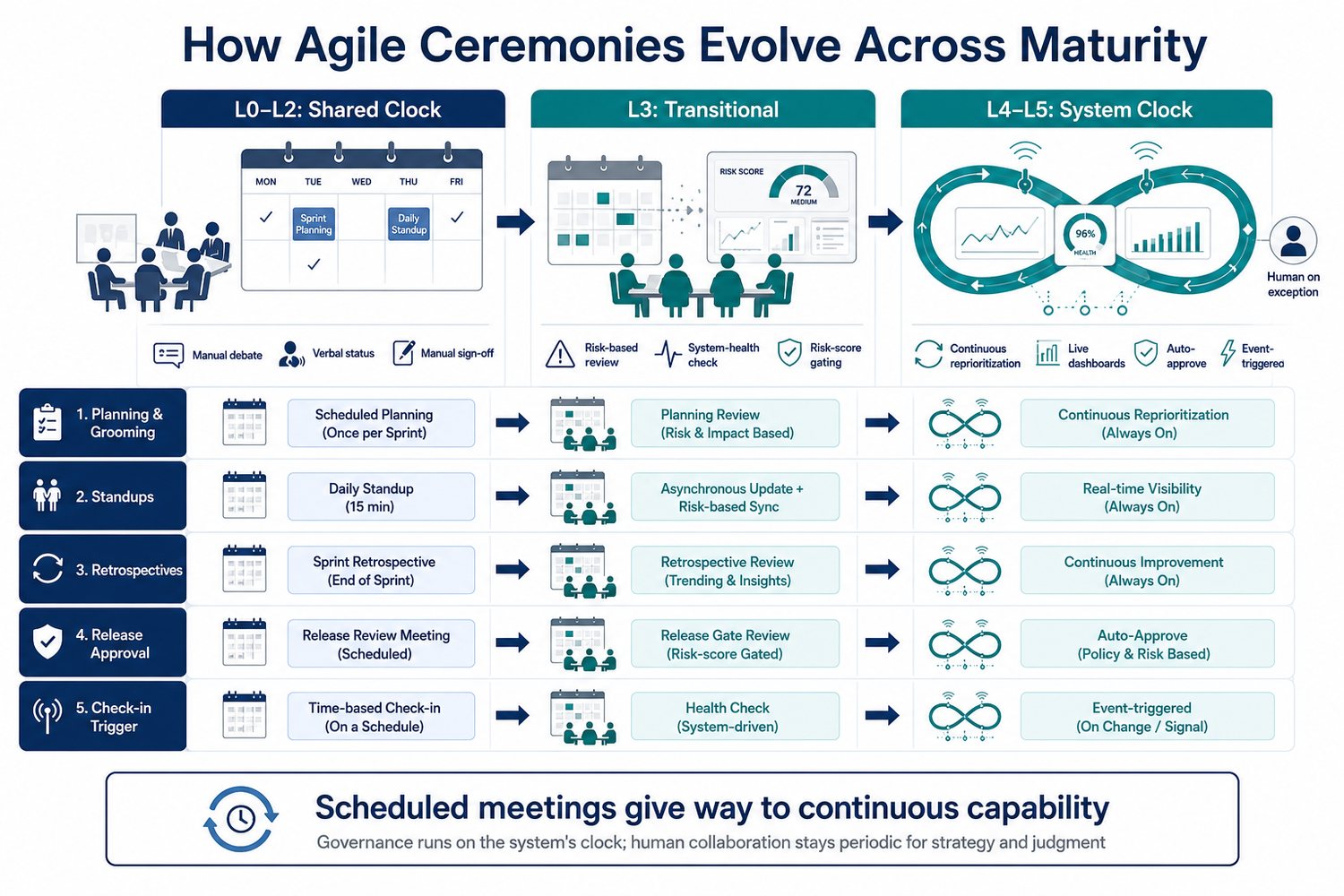
At low maturity, ceremonies and execution share a clock — and remain appropriate. As agents assume more work, ceremonies must evolve or quietly become obstructive:
| Practice | L0–L2 | L3 | L4–L5 |
|---|---|---|---|
| Planning & grooming | Manual debate; AI-assisted drafts | Risk-based review of AI-flagged issues | Continuous reprioritization from live data |
| Standups | Verbal status updates | System-health review, not task roll-call | Exception-only escalation; live dashboards |
| Retrospectives | Open discussion | Flow & signal-quality review | Continuous learning loops |
| Release approval | Manual sign-off | Risk-score gating | Auto-approve on exception |
| What triggers a check-in | The calendar | Calendar with risk-shaped agenda | Events and confidence signals |
The pattern is consistent: scheduled meetings give way to continuous capability. Governance should run on the system's clock; human collaboration — strategy, alignment, judgment — can remain periodic and, at high maturity, become less frequent rather than more.
Redundant as task management, essential as values
Ceremonies as literal meetings stop helping well before full maturity and, by Level 4–5, often impose Ceremony Debt on systems that no longer need a calendar to know what to do next. Agile as values — fast feedback, inspection, adaptation, continuous delivery — does not disappear; it graduates into self-healing loops, continuous learning, and course-correction embedded in the platform.