Overview
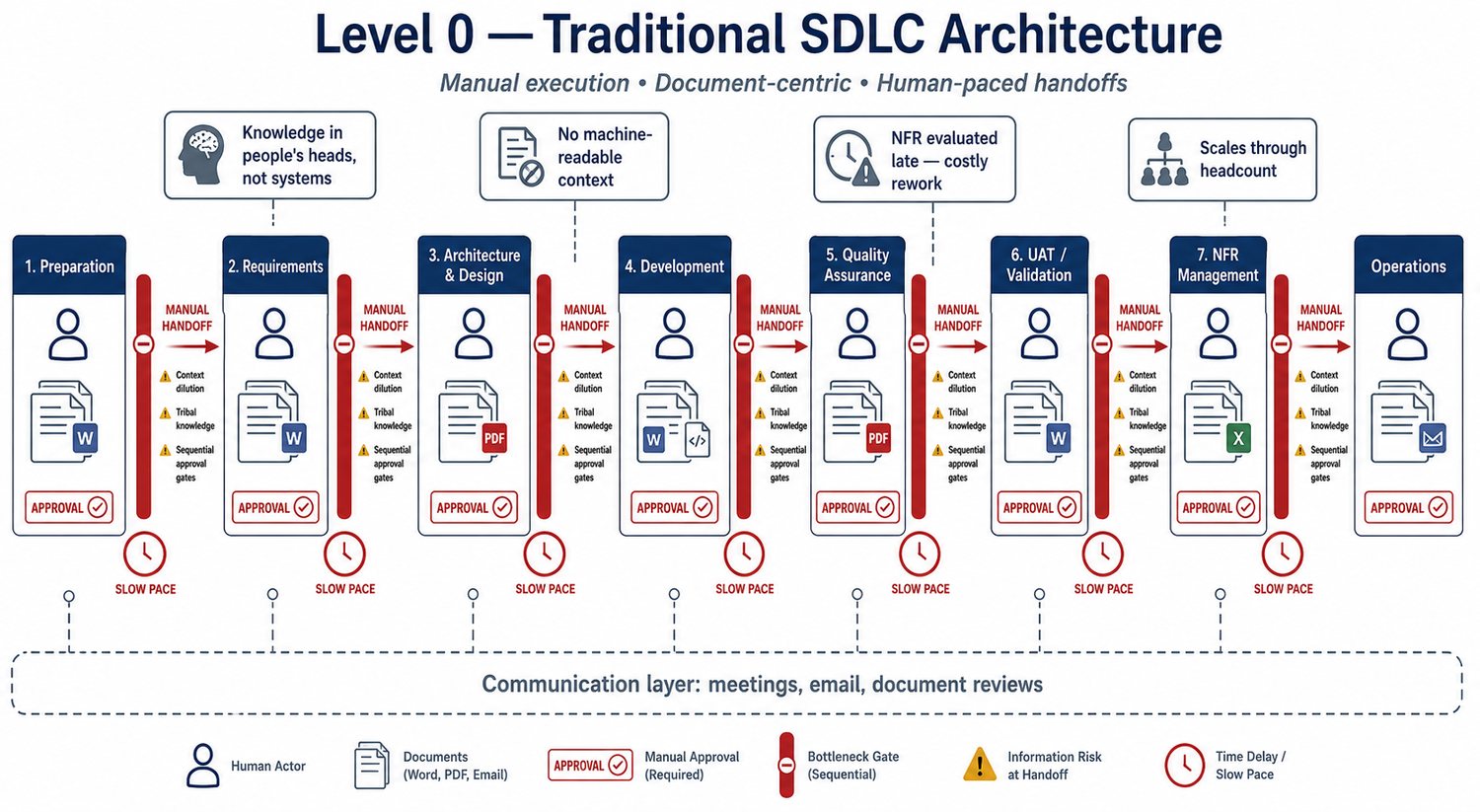
Level 0 represents the baseline maturity where software delivery is predominantly manual, process-driven, and highly dependent on human expertise. While organizations may follow either sequential Waterfall or iterative Agile practices, the execution of each phase relies heavily on manual coordination, documentation, meetings, and stakeholder approvals.
Knowledge is distributed across individuals rather than embedded into tools or automated workflows. Information handoffs between business, architecture, development, testing, and operations introduce delays, inconsistencies, and rework.
Traditional SDLC models were engineered for a deterministic era where humans translated business logic into rigid syntax.
Their reliance on sequential transfers and high-friction knowledge handoffs creates tribal knowledge bottlenecks that dilute context and stifle velocity. For decades these limitations were simply "the cost of doing business." The arrival of capable, widely available AI turned each of them into an active liability.
SDLC pillars & activities
Level 0 is best understood as a set of phase-by-phase commitments — what each part of the lifecycle is expected to produce, and how success is judged. This is the baseline every subsequent level builds on or automates away:
| Phase | Core activities | Success criteria |
|---|---|---|
| Preparation | Objectives, scope, constraints; effort estimated through expert judgment; budgets & plans prepared manually. | Approved scope, budget, executive sponsorship. |
| Requirements | Workshops & interviews; user stories, BRDs and SRS manually authored and reviewed. | Stakeholder alignment, formal sign-off. |
| Architecture & Design | Systems designed, tech stacks defined, UML diagrams created; decisions based on expertise. | Approved architecture, standards compliance. |
| Development | Developers manually translate requirements into code; local testing and peer reviews. | Feature completion, unit-test success. |
| Quality Assurance | Test strategies, manual & automated test cases; automation limited to selected suites. | High coverage, reduced defect leakage. |
| UAT / Validation | Business users validate through structured UAT; release readiness assessed through review cycles. | Business sign-off, validated value. |
| NFR Management | Security, performance, scalability evaluated late in lifecycle; issues often require costly rework. | Compliance, performance benchmarks. |
Read across the rows and a pattern emerges: every phase depends on human coordination, manual documentation, and sequential approval. Nothing in this model assumes continuous feedback, machine-readable context, or cross-phase intelligence — which is exactly what makes it a liability once AI enters the picture.
Characteristics of Level 0
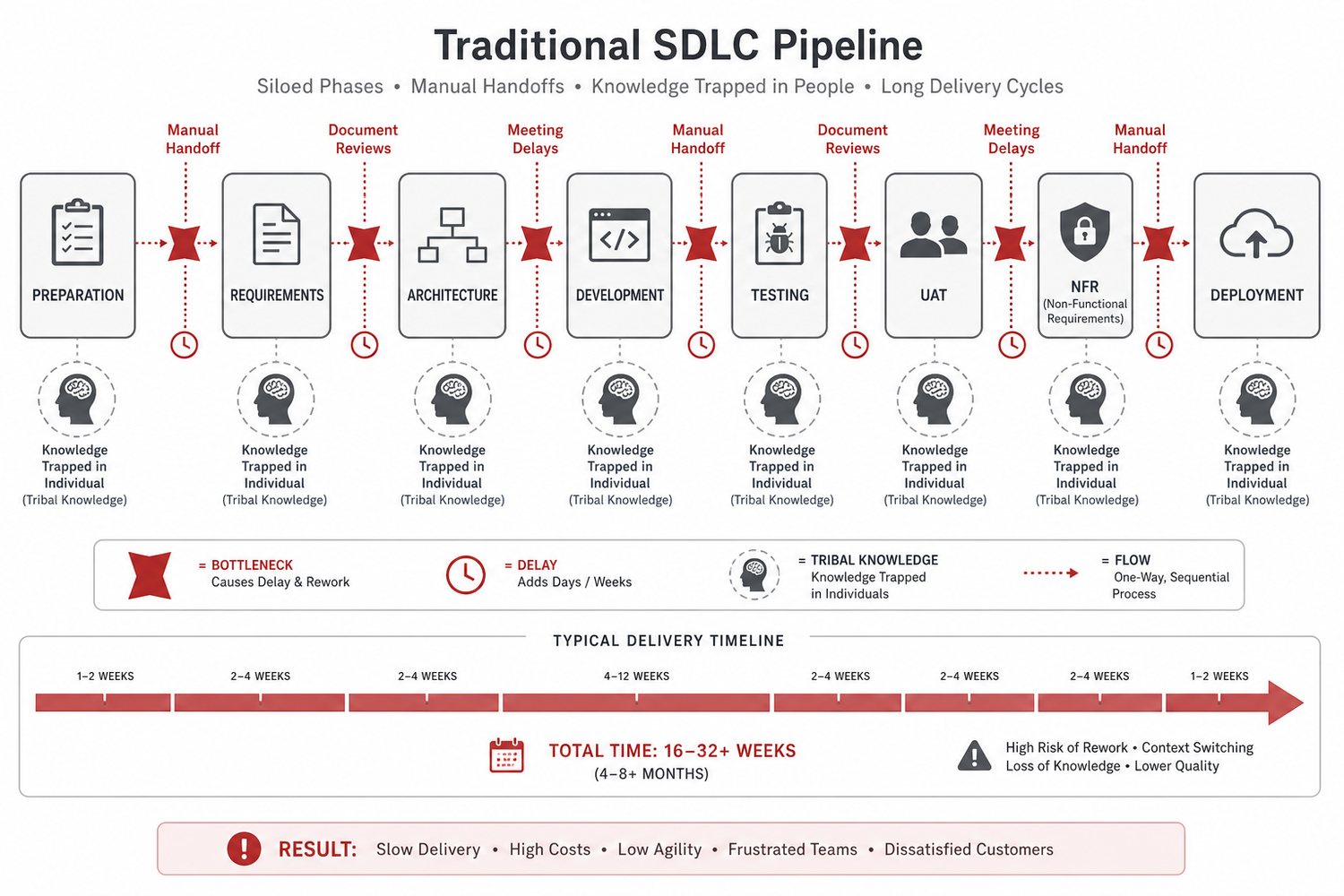
- Heavy reliance on manual execution across all SDLC phases.
- Documentation serves as the primary mechanism for communication and knowledge transfer.
- Cross-functional collaboration occurs through meetings, emails, and document reviews.
- Limited automation, intelligence, or continuous feedback loops.
- High dependency on individual expertise — inconsistent execution quality.
- Longer delivery cycles due to sequential handoffs and approval gates.
Why organizations must move beyond Level 0
Traditional models struggle with inherent friction: the multi-week delay in requirements detailing where intent is lost, the lack of architecture reconstruction for brownfield projects, and the bolt-on approach to non-functional requirements. These models served the rules-based era but are fundamentally ill-equipped for the probabilistic nature of AI-driven engineering.
Projected benefits at this level: This is the baseline every later level is measured against — fragmented traceability, typical 60–70% test coverage, high defect leakage, and very high manual effort across the chain. There is no AI acceleration to capture; the value of naming Level 0 explicitly is knowing what you are leaving behind.
Not yet applicable. Level 0 has no AI acceleration, so there is no local-versus-global speed mismatch — the entire delivery chain is uniformly slow. That uniform slowness is deceptive: it masks the bottleneck-shift problem that appears the moment AI speeds up coding at Level 1 while review, testing, and release queues remain unchanged.