Overview
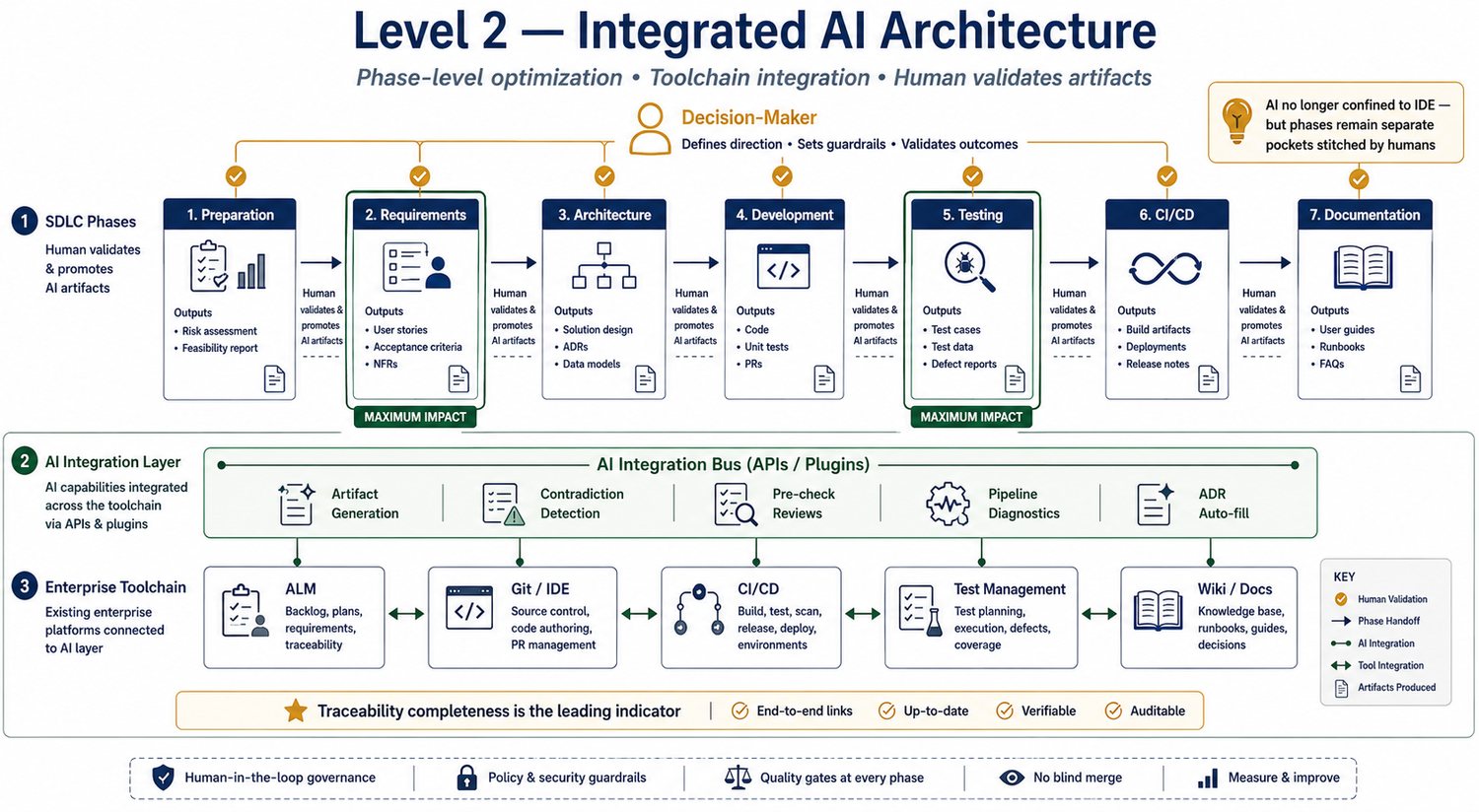
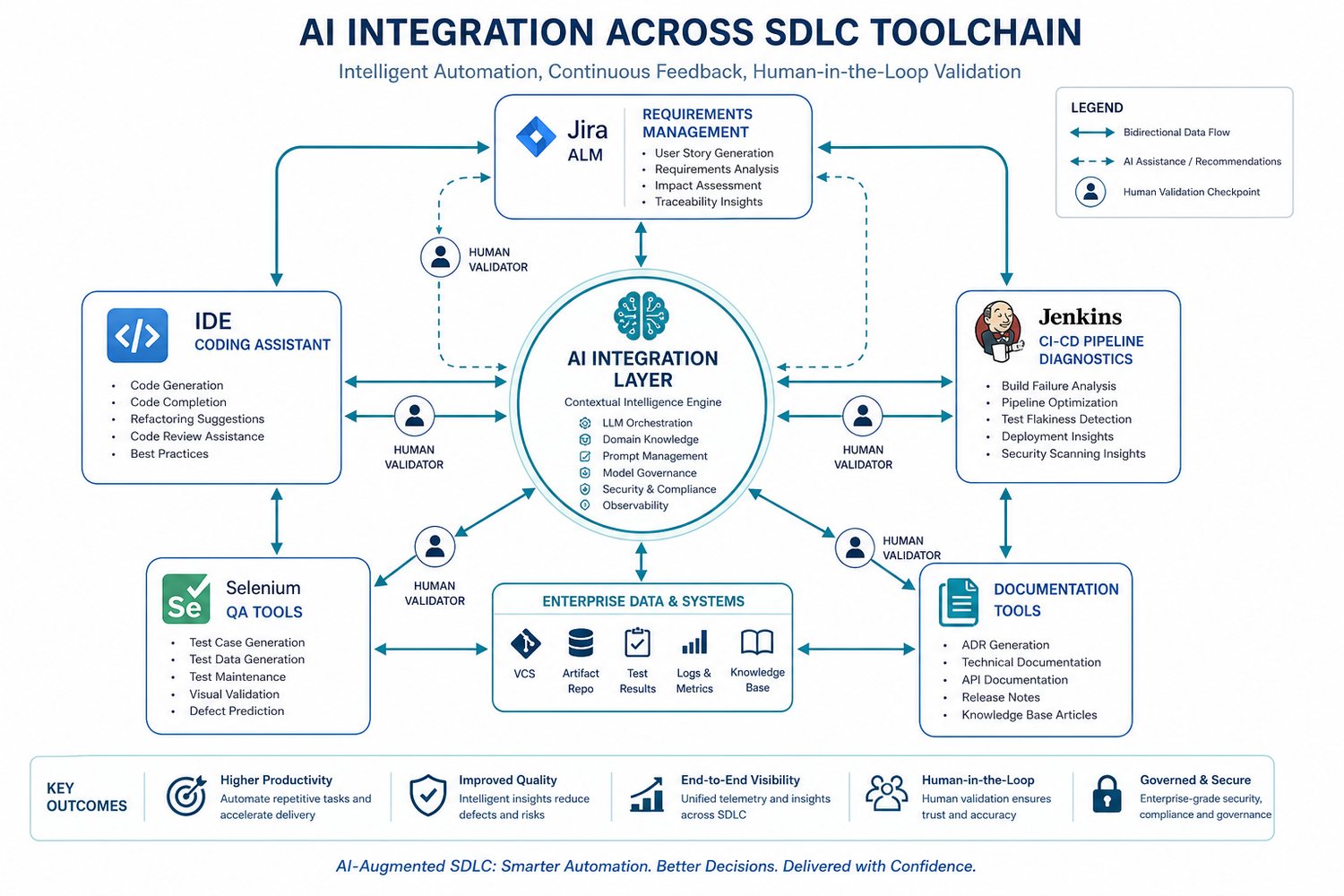
Level 2 represents a strategic shift from isolated tool adoption to integration of AI across multiple SDLC phases. Organizations move beyond simple Copilot usage to establish toolchain-level integrations where AI bridges the gap between distinct silos.
Ag‑DLC functions as a workflow accelerator that improves artifact quality and reduces friction between phase-gate handoffs. The operating model shifts from humans doing all the work to humans acting as decision-makers who validate AI-generated artifacts.
By Level 2, AI is no longer confined to the IDE — but each phase is still a separate pocket of automation, stitched together by humans.
The shift from Level 1 to Level 2
The jump is not "more Copilot" — it is AI wired into the toolchain, so outputs from one phase can feed the next without a human carrying them across:
| Pillar | Level 1 (Local) | Level 2 (Phase-level) |
|---|---|---|
| Preparation / Scoping | Basic summarization & chat-based access | AI acts as scoping analyst — drafts backlogs, assumptions, risk registers |
| Requirements | Helps format a single story | Converts business briefs into structured requirements; detects contradictions |
| Architecture & Design | Almost entirely manual | Provides architecture recommendations and trade-off analysis |
| Development | Autocomplete & boilerplate via IDE | Integrated into review workflow with pre-checks for style, security, logic |
| Testing | Standalone unit-test generation | Comprehensive test suites integrated into ALM and QA tools |
| CI/CD | Manual pipeline management | Pipeline diagnostics and failure remediation |
| Documentation | Task-by-task inline comments | Auto-fills ADRs and technical specifications |
Pillars of maximum impact
While Development continues to see gains, Requirements and Testing experience the most transformative impact:
- Requirements (High Impact): AI-driven drafting and validation reduces first-draft time by an estimated 50–90%, improving quality score from "Low" to "Medium."
- Testing (High Impact): Test coverage scales from a traditional 60–70% baseline to an estimated 80–95% as AI explores edge cases beyond human capacity.
Projected benefits: Phase-level quality begins to compound — test coverage rising to an estimated 80–95%, requirement quality moving from Low to Medium, defect leakage starting to fall, and AI rework easing from High to Medium as ALM, DevOps and QA integrations give AI persistent context across phases.
Partial relief. Requirements and test artifacts improve in quality, reducing some downstream rework — but handoffs between phases are still human-mediated, so local gains can dissipate at phase boundaries. Traceability completeness is the leading indicator: if rework and defect leakage are not falling, the organization is relocating paradox debt rather than resolving it.
Exit criteria for Level 2
Level 2 is complete when AI-generated artifacts are routinely used as the primary starting point for work across requirements, design, coding, and testing, and the organization sees measurable reduction in defect leakage. Most individual SDLC phases now have meaningful AI participation — but each is still stitched together by humans. This sets up the natural next question: what happens when AI itself starts coordinating across phases?