Overview
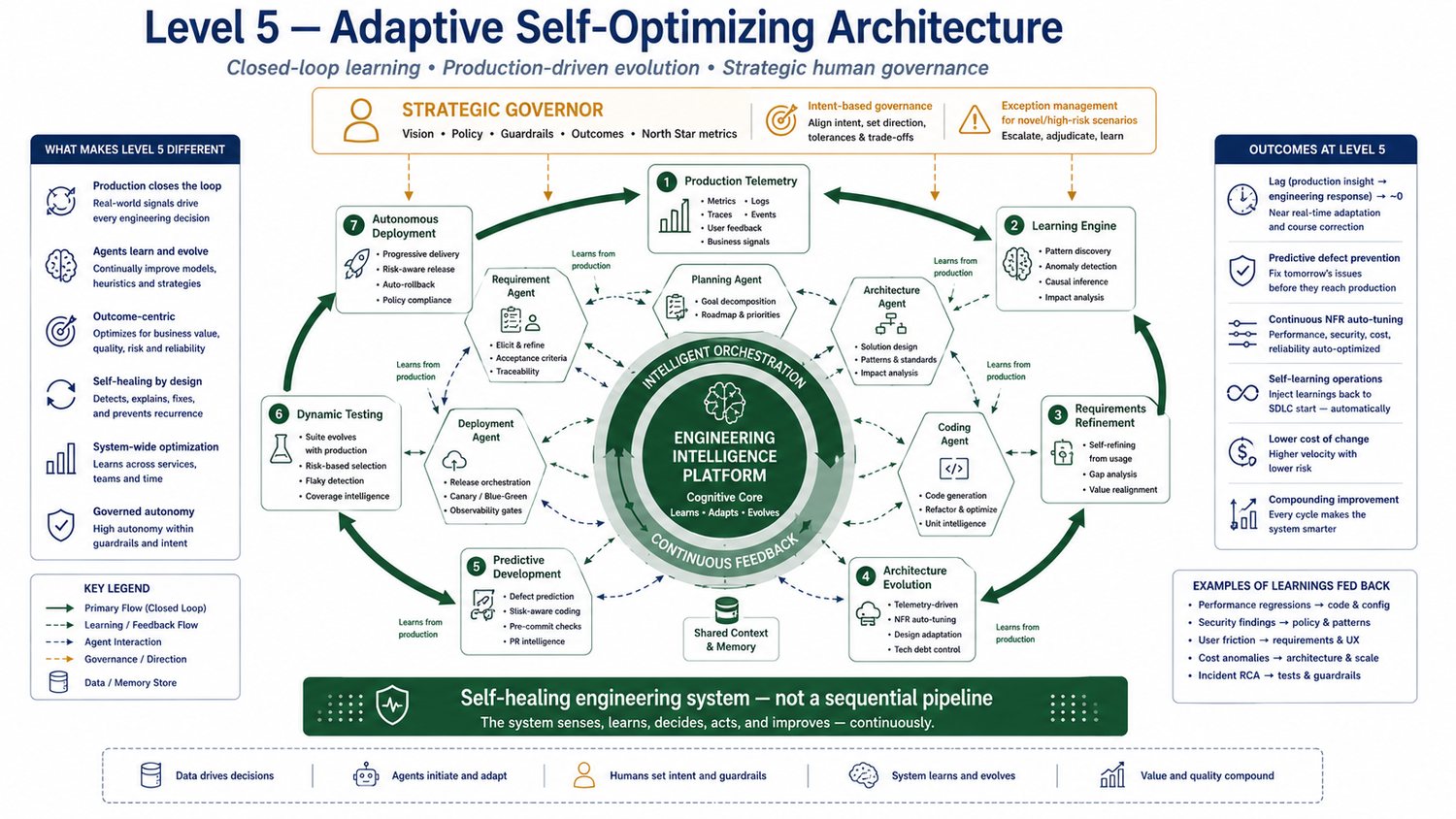
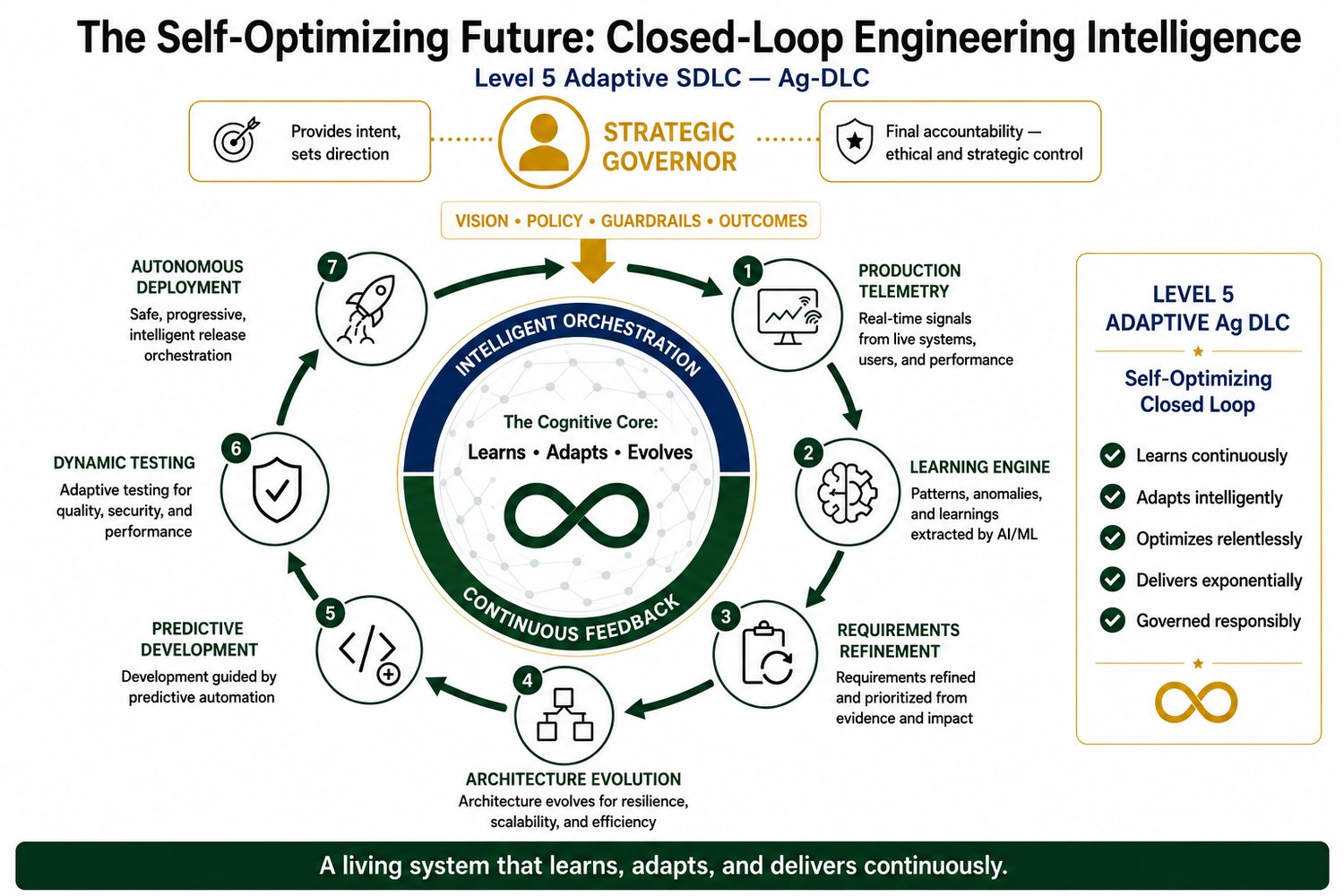
Level 5 represents the theoretical pinnacle of engineering intelligence — a closed-loop system where the SDLC continuously learns from production data to optimize every upstream phase. The distinction between development and operations blurs as the platform evolves autonomously.
Ag‑DLC transcends being a tool or agentic system; it becomes a self-improving engineering intelligence platform that eliminates the lag between production insights and engineering responses.
The lag between "something happened in production" and "the system adapted" — hours or days at Level 4 — approaches zero at Level 5.
The shift from Level 4 to Level 5
Level 5 is not "more agents" — it is agents that learn. The same pillars governed by autonomous agents at Level 4 now close the loop with production data.
| Pillar | Level 4 (Autonomous) | Level 5 (Adaptive) |
|---|---|---|
| Preparation | Planning agents build roadmaps autonomously | Predictive scoping continuously learning from production & market data |
| Requirements | Requirement agents update downstream artifacts | Requirements self-refining based on production usage patterns |
| Architecture | Validate designs against standards | Autonomous architecture evolution from real-time performance telemetry |
| Development | Coding agents in repair loops | Predictive prevention blocks sub-optimal patterns from historical defect data |
| Quality & Testing | Self-healing tests continuously | Dynamic test-suite evolution based on current production state |
| NFR Management | Policy-as-Code guardrails | Continuous NFR optimization, auto-tuning system parameters |
| Operations | Operations agents detect & remediate | Self-learning operations inject incident learnings back into SDLC start |
How Ag‑DLC helps at Level 5
- Closed-loop evolution — production telemetry, performance data, and incident patterns continuously retrain models and refine standards.
- Predictive defect prevention — historical patterns prevent defects before a single line of code is committed.
- Autonomous resource & architecture optimization — real-time usage data drives architectural evolution.
- Minimal manual intervention — strategic governance remains human-led; tactical execution is near-zero manual.
Projected benefits
A near-complete digital thread — >90% AI coverage and traceability approaching 100% — with defect leakage shifting from reactive fix to predictive prevention, requirements self-refining from production feedback, and release cadence continuously optimized against live risk and value signals rather than fixed calendars.
Prevented, not just resolved. The system anticipates and prevents bottlenecks — and defects — before they occur, using production telemetry to continuously rebalance the pipeline. The delivery chain no longer waits for a mismatch to become visible before correcting it.
A new tension can emerge: with autonomous decision volume, organizations risk a Governance Paradox — recreating the audit-layer bottleneck the journey removed from code review. Production signals can be gamed once users learn what the system optimizes for. Skill rot deepens for strategic governors who rarely work with agents or pipelines. And not every system belongs here: trading platforms, core banking ledgers, and regulated healthcare may permanently cap at supervised autonomy regardless of technical capability. Full adaptive maturity is a competitive destination for some products, not a universal organizational badge.
Human governance at Level 5
Human governance undergoes its final transformation to a purely strategic supervisory and accountability role:
- Strategic supervisory model — human involvement restricted to highest-level oversight.
- Intent-based governance — humans define North Star metrics, constraints, and ethical boundaries.
- Oversight of closed-loop learning — monitor predictive defect prevention for biases; audit value-stream outcomes.
- Exception management — human gates mandatory for high-risk or novel scenarios; manual intervention becomes the exception that teaches the system.
At Level 5, the SDLC no longer functions as a sequential process but as a self-healing engineering system that continuously optimizes itself based on data. The lag between production insights and engineering responses approaches zero.