Why Unplugged Days exist
At high maturity, the people accountable for autonomous systems gradually lose touch with how those systems actually work. Dashboards, exception queues, and agent summaries create an illusion of understanding — but when something genuinely novel breaks, the supervisor who has not touched the codebase in months may be unable to reason to a fix.
This is skill atrophy: manual capability erodes not because it was never learned, but because it is no longer exercised.
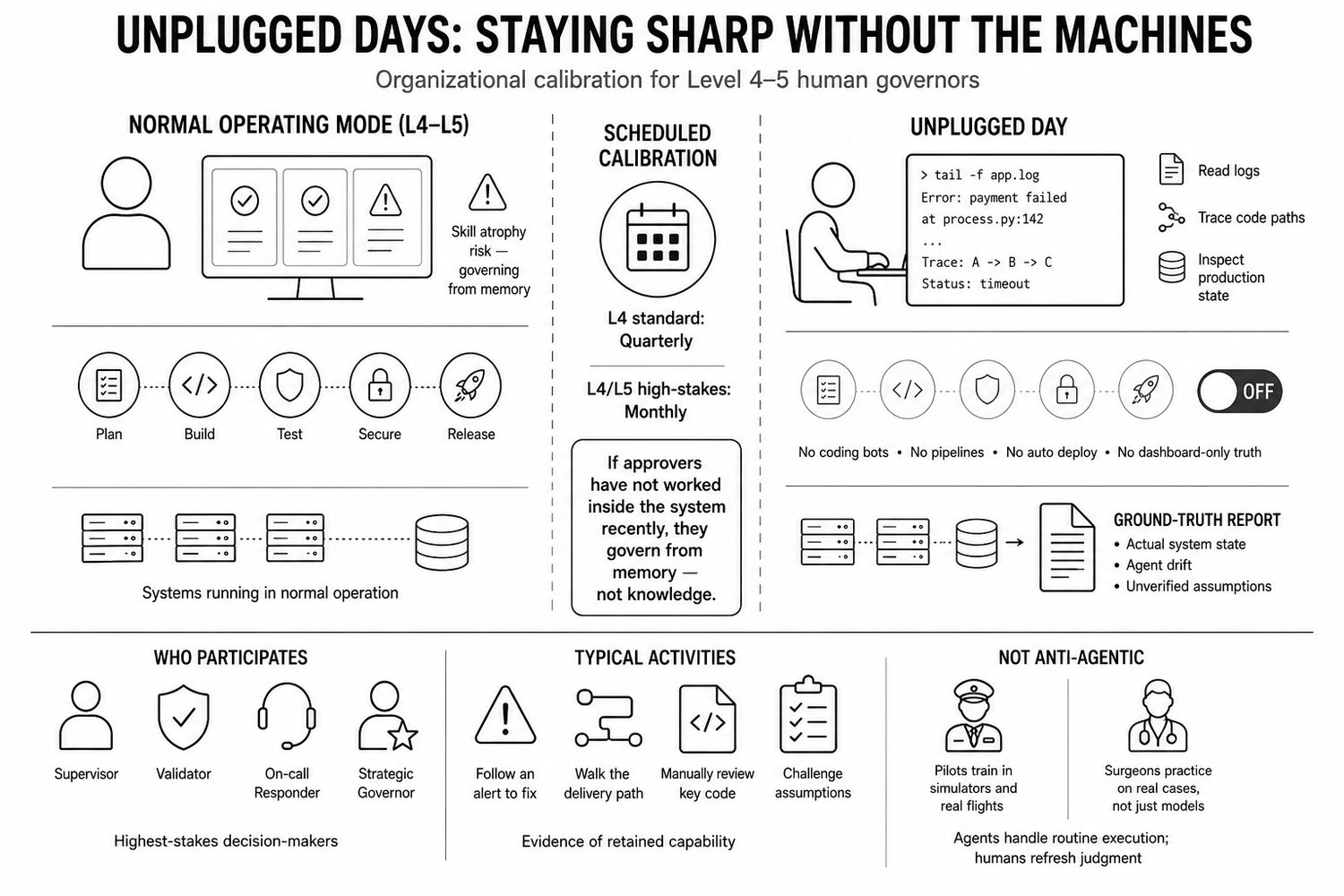
Unplugged Days are the organizational countermeasure: scheduled periods where Level 4 and Level 5 teams work without AI assistants, agent orchestration pipelines, or automated delivery tooling. The practice is not nostalgia for Level 0 and not a rejection of agentic maturity — it is calibration, ensuring the humans who govern autonomous systems still understand them from the inside.
What gets turned off — and who participates
On an Unplugged Day, high-maturity teams deliberately step out of the agentic operating model: no coding or review bots, no agent pipelines, no automated deploy or rollback, and no pre-generated dashboards as the sole source of truth. Participants read logs, trace code paths, and inspect production state directly.
This is not a junior-engineer exercise. It matters most for system managers, supervisors, validators, strategic governors, and on-call responders — the people whose judgment carries the highest stakes when autonomy fails. If only junior staff participate, the organization preserves craft at the bottom while decision-makers at the top continue to drift from the system's real state.
Activities and expected output
An Unplugged Day should produce evidence of retained capability, not morale theater. Typical activities include tracing a production issue manually from alert to fix, walking a small change through the full delivery path by hand, reconstructing a recent module without AI assistance, and documenting where governance assumptions diverge from ground truth.
The deliverable is a ground-truth report: what the system actually looks like today, where agents have drifted the architecture, and which beliefs the governance layer has been operating on without verification. Throughput is not the metric; restored judgment is.
Cadence
Unplugged Days should be regular, scheduled, and non-negotiable — deferred delivery pressure is exactly when skill rot is most dangerous.
| System criticality | Suggested cadence | Scope |
|---|---|---|
| Level 4 · standard systems | Quarterly | One full day per team; all supervisors participate. |
| Level 4 · high-stakes systems | Monthly | One full day; includes cross-team incident simulation. |
| Level 5 · adaptive systems | Monthly | One full day; verify closed-loop assumptions against ground truth. |
| Level 5 · capped critical infrastructure | Monthly | One full day; mandatory for all approvers and governors. |
Not anti-agentic — an extension of known practice
Unplugged Days extend individual no-AI practices to the governance layer: pausing orchestration pipelines, requiring approvers — not only implementers — to participate, and producing evidence that accountability is backed by capability. Pilots still fly aircraft; surgeons still review anatomy when robots assist. Agents handle routine execution so humans can focus on judgment — but judgment requires a periodically refreshed understanding of what is being judged.
Without this practice, organizations risk a quiet inversion: the system runs itself, humans approve its outputs, and over time neither party truly knows the current state of the other. Unplugged Days keep human governors sharp, current, and capable of intervention — not as a daily fallback, but as a proven reserve for the day agents cannot.