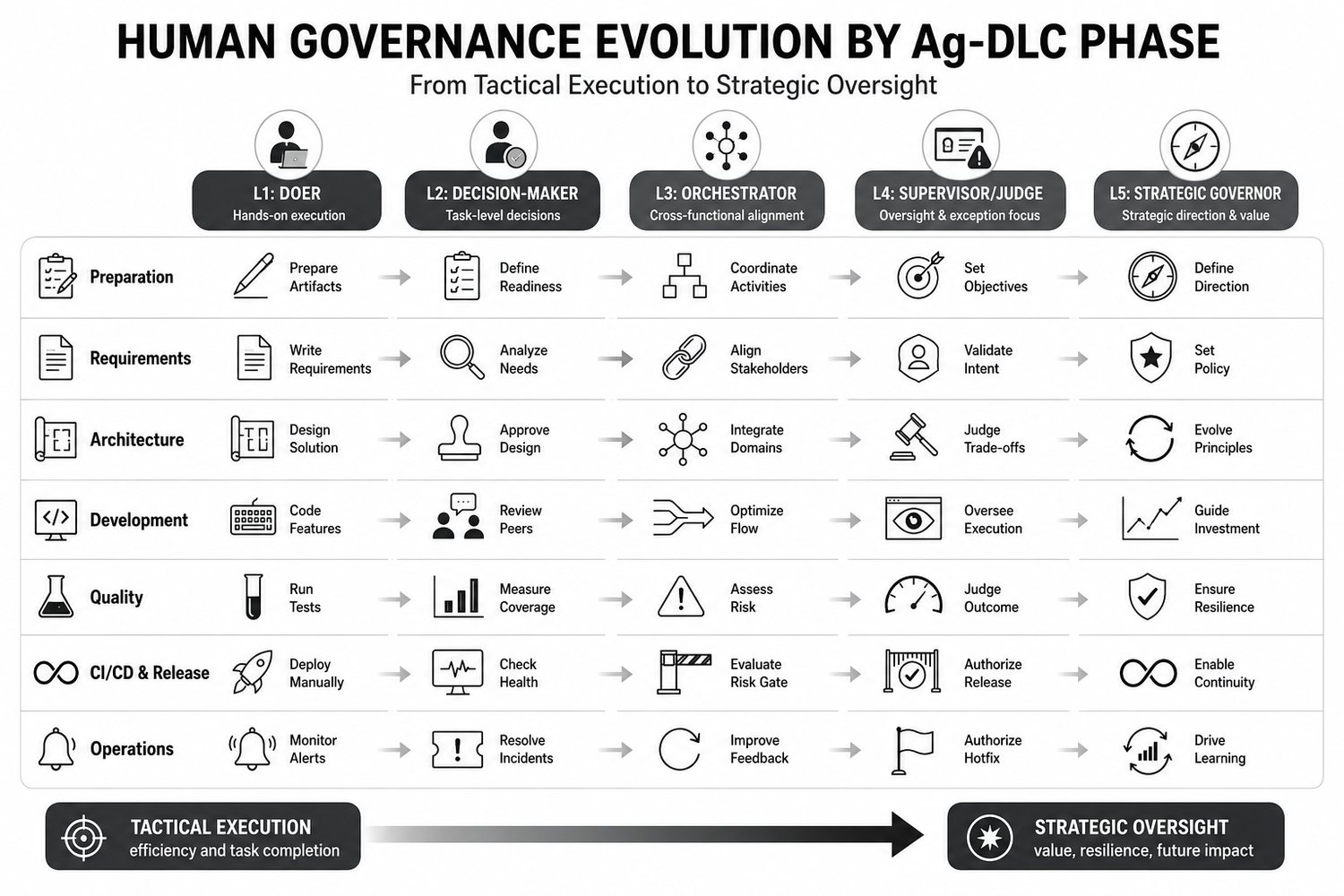
Governance evolution by SDLC phase
Human governance is not a single role that fades over time — it morphs differently in each SDLC phase. Read down any column and you see a coherent career arc for that maturity level. Read across any row and you see how governance for a single concern — say, release approval — escalates from hands-on operation to strategic oversight as agents take over execution.
| Phase | L1 · Doer | L2 · Decision-Maker | L3 · Orchestrator | L4 · Supervisor | L5 · Governor |
|---|---|---|---|---|---|
| Preparation | Prepare artifacts | Define readiness | Coordinate activities | Set objectives | Define direction |
| Requirements | Write requirements | Analyze needs | Align stakeholders | Validate intent | Set policy |
| Architecture | Design solution | Approve design | Integrate domains | Judge trade-offs | Evolve principles |
| Development | Code features | Review peers | Optimize flow | Oversee execution | Guide investment |
| Quality | Run tests | Measure coverage | Assess risk | Judge outcome | Ensure resilience |
| CI/CD & Release | Deploy manually | Check health | Evaluate risk gate | Authorize release | Enable continuity |
| Operations | Monitor alerts | Resolve incidents | Improve feedback | Authorize hotfix | Drive learning |
Key strategic shifts
- From Syntax to Intent (L1 → L4): Governance moves from the "how" (syntax, style) to protecting "intent," where humans judge the agent's reasoning trajectory.
- Built-in Policy-Driven Governance (L4 → L5): Manual checklists are replaced by Policy-as-Code; governance becomes intent-based with North Star metrics.
- The Responsible AI Constant: "AI everywhere; humans who deploy it remain accountable always." Governance at Level 5 is not the absence of human control, but its strategic elevation.
Governance at Level 5 is not the absence of human control, but its strategic elevation.