Overview
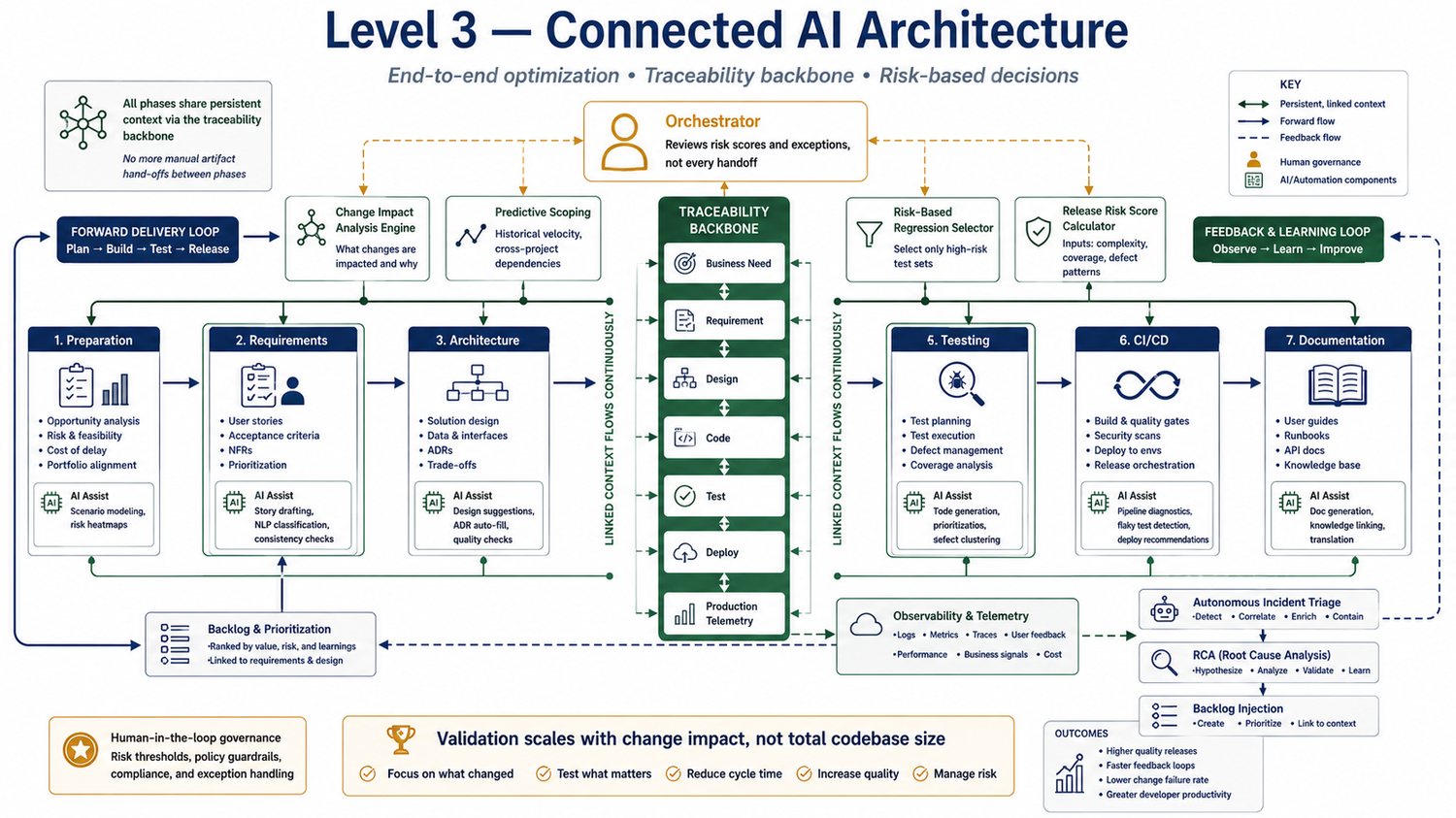
Level 3 is the pivotal shift from optimizing individual phases to orchestrating the entire delivery value stream. The enterprise moves beyond siloed automation, establishing a continuous intelligence loop where data and insights flow seamlessly across the full SDLC.
Ag‑DLC functions as a value-stream orchestrator, beginning to resolve the Productivity Paradox by ensuring speed in one phase is matched by intelligence-driven throughput in another.
Predictive intelligence replaces reactive handoffs — scoping informed by history, testing selected by risk, releases gated by multi-phase signals rather than calendar dates.
The shift from Level 2 to Level 3
Level 3's defining move is connectivity: the same pillars that Level 2 improved in isolation now share context, traceability, and feedback loops.
| Pillar | Level 2 (Integrated) | Level 3 (Connected) |
|---|---|---|
| Preparation & Scoping | Drafts backlogs from current project inputs | Predictive scoping using historical velocity & cross-project dependencies |
| Requirements | Structured stories, medium quality | High-fidelity requirements with near-complete traceability |
| Architecture & Design | Suggests patterns, drafts ADRs | Automated change-impact analysis mapping design to business processes |
| Development | Copilot generation + automated peer reviews | Code commits verified against linked requirements & tests |
| Quality & Testing | Comprehensive test suites | Risk-based regression selecting tests by change impact |
| CI/CD | Pipeline diagnostics & optimization | Release risk scoring from multi-phase data signals |
| Operations | Log summarization & basic diagnostics | Autonomous incident triage with RCA fed back to backlog |
How Ag‑DLC helps at Level 3
- Continuous feedback loops — production performance informs future engineering decisions.
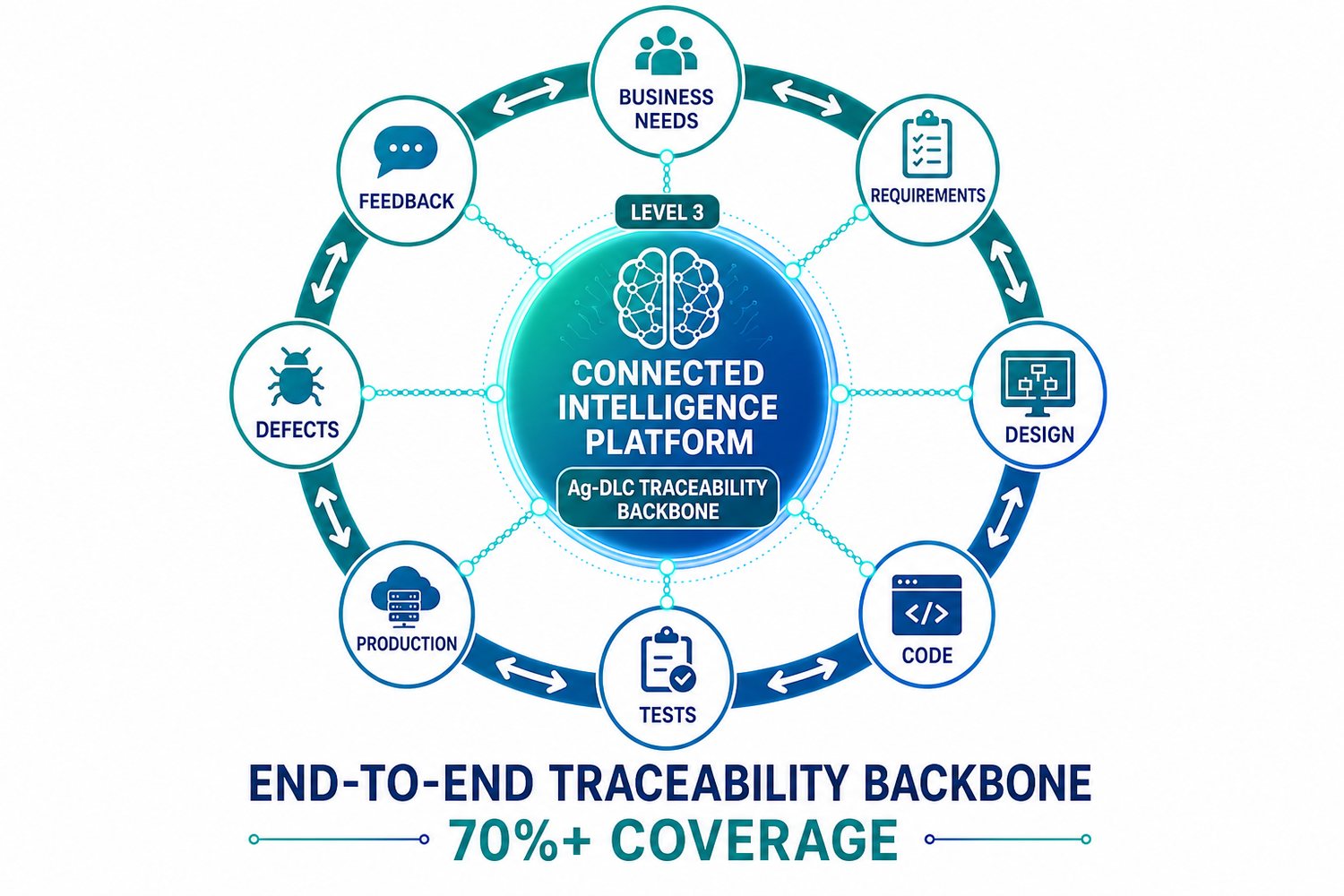
- End-to-end traceability — AI maintains links between business needs, requirements, design, code, tests, and production defects: the "traceability backbone."
- Intelligent change-impact analysis — AI predicts ripple effects of changes across the entire architecture.
- Risk-based decision support — AI generates Release Risk Scores evaluating complexity, coverage, and defect patterns.
Projected benefits
The first measurable end-to-end gains appear — directional 16–30% overall productivity and 31–45% software quality improvement, traceability completeness above 70%, requirement quality reaching Medium-High, and shorter, more predictable release cycles through risk-based testing and release scoring.
Significant relief. End-to-end traceability and risk-based regression mean validation effort scales with actual change impact instead of total codebase size — closing much of the gap between coding speed and validation speed. Validation becomes targeted, not exhaustive. Confirm the risk scoring genuinely reduces manual effort, rather than layering a dashboard on top of a still-manual regression suite.
Level 3 is where continuous, machine-paced intelligence first strains calendar-based Agile mechanics. Sprint boundaries that organized human work can now throttle the insights the traceability backbone generates in real time — finished work waiting for the next standup or sprint review because the meeting, not system readiness, gates the decision. Organizations should begin evolving ceremonies from task-management rituals toward risk-based governance checkpoints.
Exit criteria for Level 3
Level 3 is complete when AI-generated insights are a standard requirement for all major delivery decisions — from scoping and architectural trade-offs to risk-based testing and release approvals. Confirm that risk-based testing and release risk scoring are genuinely reducing validation effort, not simply adding another dashboard on top of a still-manual regression suite. The organization is ready for Level 4 when connected intelligence can be elevated to autonomous agentic orchestration.