Overview
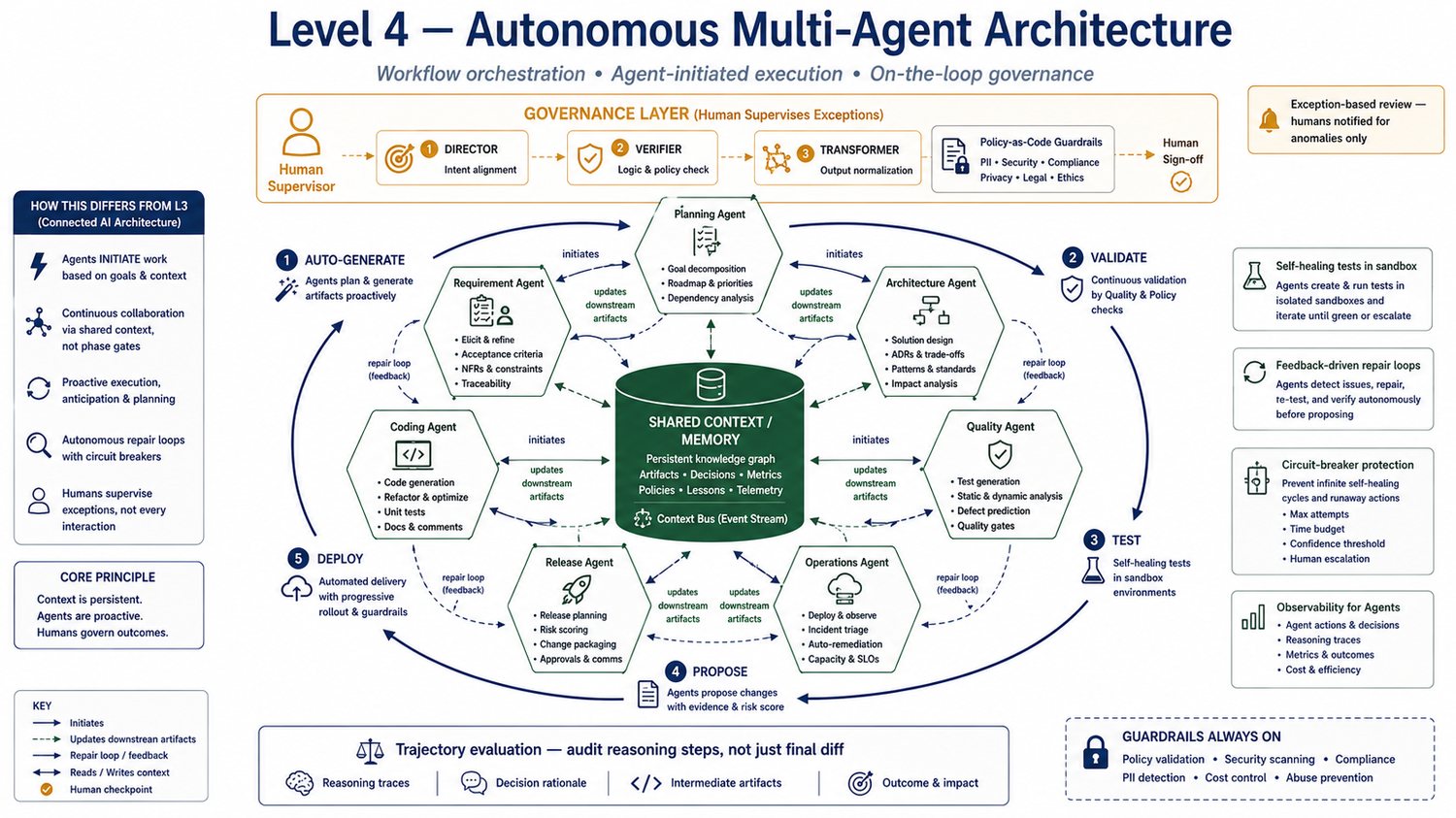
Level 4 represents a paradigm shift from a deterministic model to a probabilistic, agentic model. The SDLC transitions from being assisted by AI to being orchestrated by AI agents that plan, coordinate, and execute workflows — with humans providing high-level governance and strategic approvals.
Ag‑DLC functions as an autonomous agentic system where AI shifts from a Copilot that waits for prompts to an active participant that understands goals and initiates tasks.
How Ag‑DLC helps at Level 4
- End-to-end workflow automation — "auto-generate → validate → test → propose → deploy" loops.
- Agentic orchestration — domain-specific agents (Requirement, Design, Coding, Quality, Release, Operations) collaborate through shared context.
- Governance-by-design — Director–Verifier–Transformer checkpoints ensure human accountability.
- Operational resilience — feedback-driven repair loops where agents self-diagnose and fix issues in sandboxed environments.
Pillar evolution — Levels 1–3 to Level 4
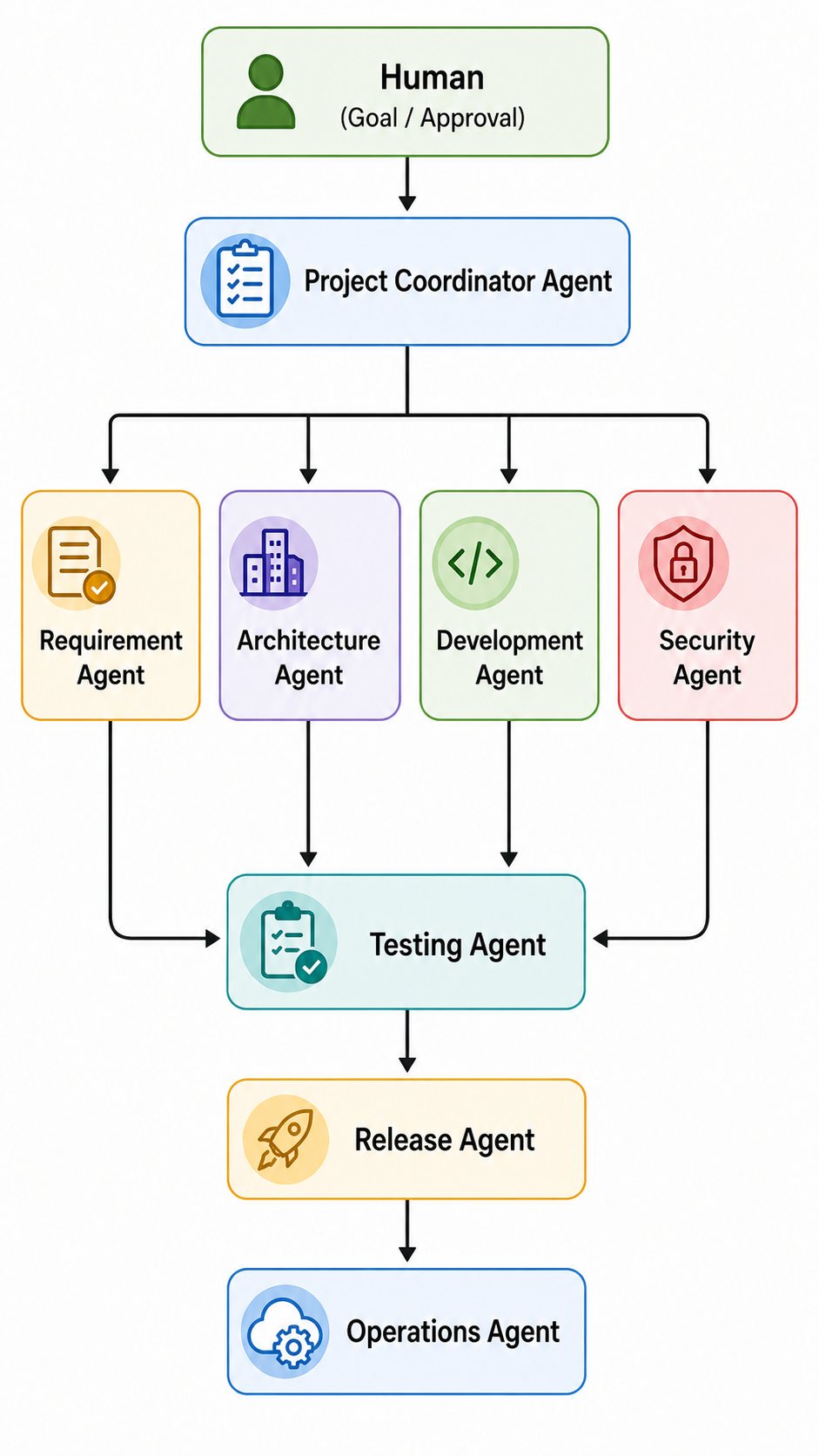
Level 4 is where named agents replace phase-level tooling. What changes is not just automation depth — it is agency. Each pillar has a domain agent that can initiate work, not merely respond to prompts.
| Pillar | Intermediate (L3) | Level 4 (Autonomous) |
|---|---|---|
| Preparation | Predictive scoping from historical velocity | Planning Agent builds roadmaps & coordinates stakeholders |
| Requirements | High-fidelity traceability across backlog | Requirement Agent autonomously updates downstream artifacts |
| Architecture | Automated change-impact analysis | Architecture Agent validates designs against standards overnight |
| Development | Linked to traceability chain | Coding Agent executes multi-file plans in repair loops |
| Quality & Testing | Risk-based regression selection | Quality Agents execute self-healing tests continuously |
| CI/CD | Release risk scoring | Release Agent manages deployment & rollbacks autonomously |
| Operations | RCA fed back to backlog | Operations Agents detect, diagnose, and remediate incidents |
Human governance at Level 4
Human governance shifts from "in-the-loop" execution to "on-the-loop" strategic supervision:
- Supervisor-Validator model — engineers express intent and validate results; agents handle implementation.
- Director–Verifier–Transformer checkpoints — mandatory gates where logic and output are verified against project goals.
- Trajectory evaluation — auditing the reasoning steps, not just the final artifact.
- Policy-as-Code guardrails — PII detection, security standards enforced automatically before human sign-off.
- Exception-based review — humans notified only for exceptions or final governance review.
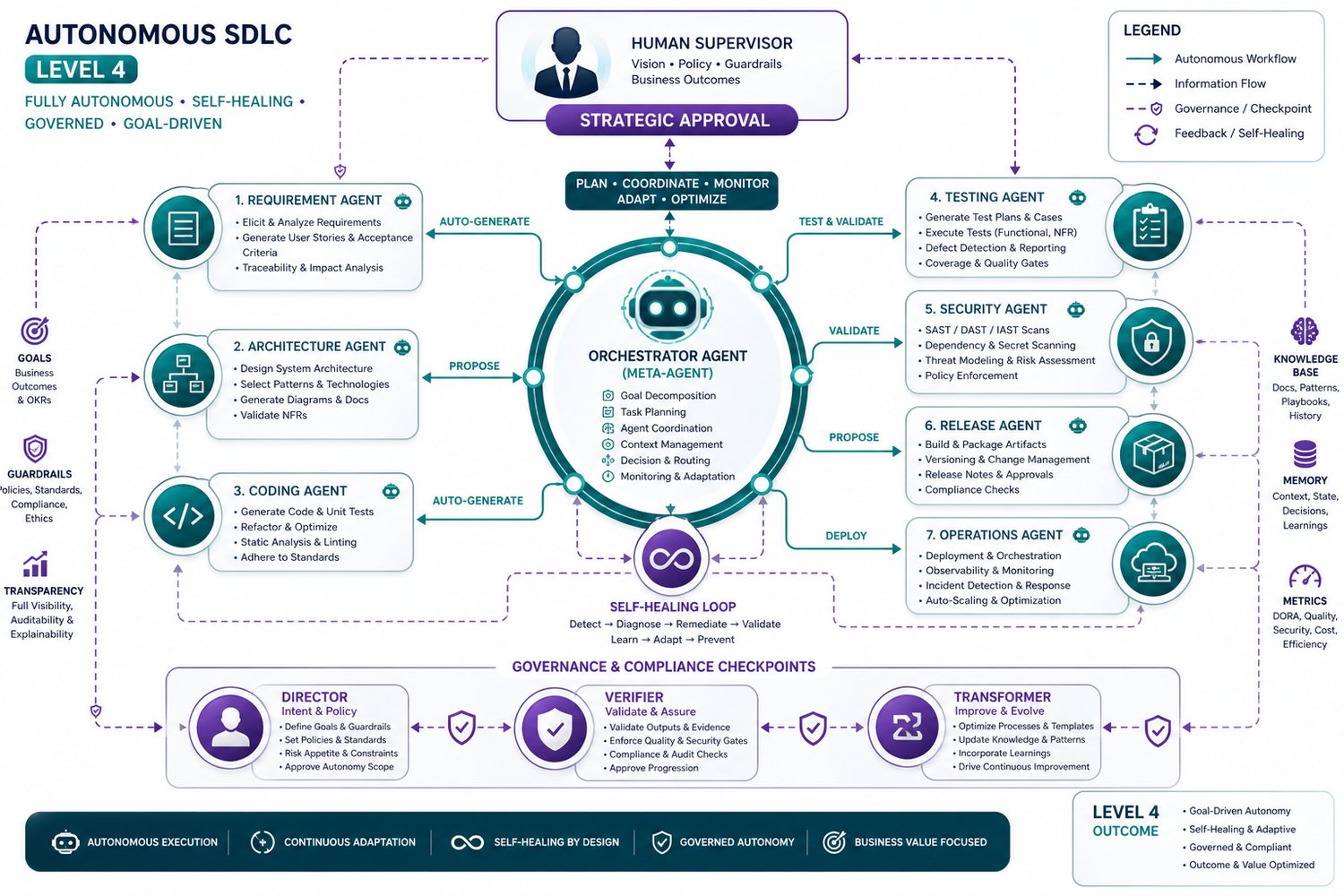
Structurally resolved. Because agents — not humans — coordinate the handoffs between requirements, code, tests, and release, the person-mediated bottleneck that caused the paradox at Levels 1–2 is largely engineered away. The residual risk shifts: throughput mismatch is no longer the constraint — governance and auditability are. Trajectory evaluation accuracy and policy compliance rate become the leading indicators.
Autonomy introduces failure modes that assisted maturity never surfaces: agentic loops (a coding agent breaks one test while fixing another, triggering endless repair cycles), agent-to-agent contradiction (well-reasoned but incompatible proposals with no human arbiter), trajectory review overload (audit queues growing unsustainably or collapsing into rubber-stamping), and skill rot (governance titles without the craft to diagnose a novel failure). These should be designed against before claiming higher maturity — not discovered in production.
Exit criteria for Level 4
Level 4 is complete when the enterprise has established a stable, multi-agent ecosystem where the engineer's primary role has evolved from "doer" to "supervisor/validator" of an autonomous delivery machine. New risks emerge at this stage — agentic loops, inter-agent conflict, audit-queue overload, and eroding hands-on skill — that only compound if the organization pushes toward closed-loop adaptation without addressing them first.