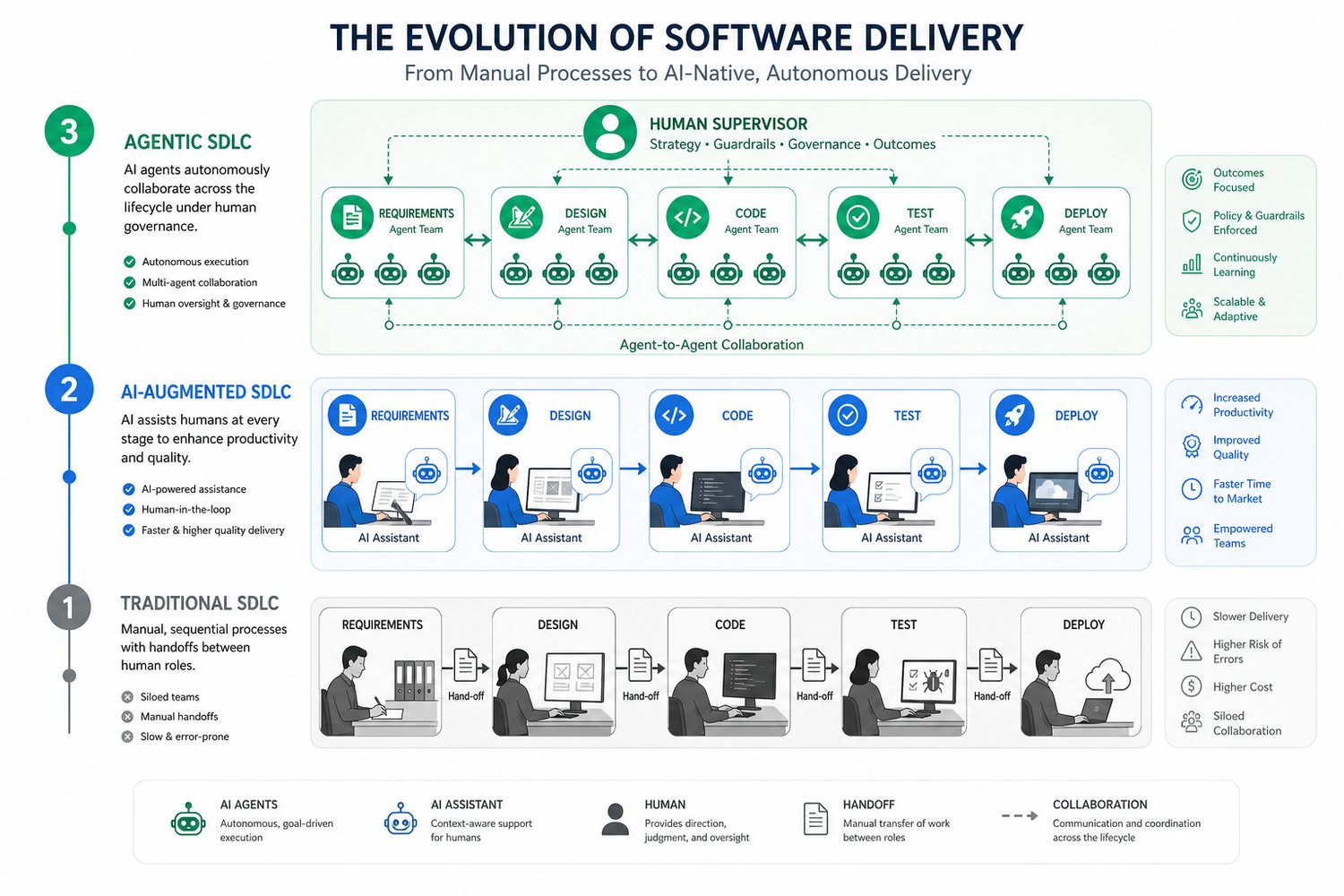
The distinction is execution, not presence
Having walked through Levels 0–2, we have seen AI evolve from "absent" to "personal Copilot" to "integrated across multiple phases." At this point it is worth pausing to name the more fundamental architectural shift that Levels 3–5 represent — because it is not simply "more of the same, but better." It is a change in who initiates and coordinates the work.
The distinction between what we might call AI SDLC (Levels 1–2, and much of Level 3) and Agentic SDLC (Levels 4–5, with the transition beginning in Level 3) is not about whether AI is used, but how work is executed.
The comparison
This table is the hinge of the entire framework. The question is who initiates and coordinates the work:
| Aspect | AI SDLC (Levels 1–2) | Agentic SDLC (Levels 3–5) |
|---|---|---|
| Primary role of AI | Assistant / Copilot | Autonomous agent |
| Decision making | Human-led | AI-initiated with human approval |
| Workflow | Human orchestrated | AI orchestrated (multi-agent) |
| Execution | Reactive (user prompts AI) | Proactive (AI initiates tasks) |
| Context | Task-specific / transient | Persistent project context / shared memory |
| Collaboration | Human + AI | Multiple AI agents + humans |
| Automation | Task automation | End-to-end workflow automation |
| Governance | Manual approvals | Built-in policy-driven approvals |
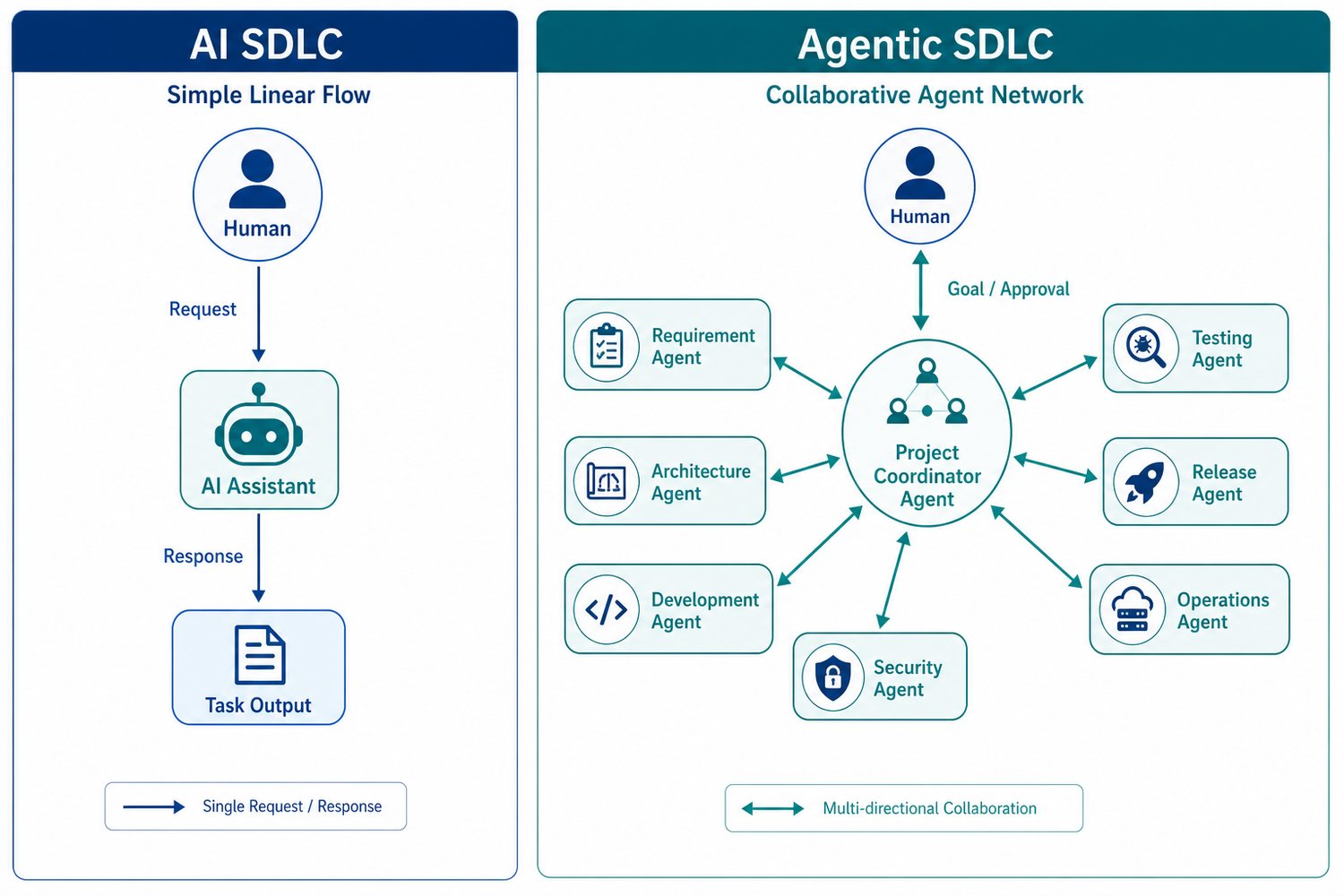
Why this matters now, not earlier
At Levels 0–2, AI could only ever be as good as the human orchestrating it — every handoff between requirements, design, code, and test still passed through a person deciding "what next." That ceiling is precisely what causes the Productivity Paradox to persist through Level 2: local phases speed up, but the person-mediated handoffs between them remain a fixed cost.
Levels 3 onward remove that ceiling progressively — letting AI itself hold context across phases and, eventually, initiate the handoffs.
Enterprise value comparison
The architectural distinction translates into different kinds of organizational outcomes. Teams optimizing for local productivity and teams transforming end-to-end delivery are pursuing genuinely different objectives:
| Dimension | AI SDLC (Levels 1–2) | Agentic SDLC (Levels 3–5) |
|---|---|---|
| Objective | Improve individual & phase productivity | Transform software delivery end-to-end |
| Typical outcomes | Faster coding, better docs, better test coverage | End-to-end workflow automation, self-healing pipelines |
| Best suited for | Team-level productivity, incremental adoption | Large enterprises, regulated industries, platform engineering |