Overview
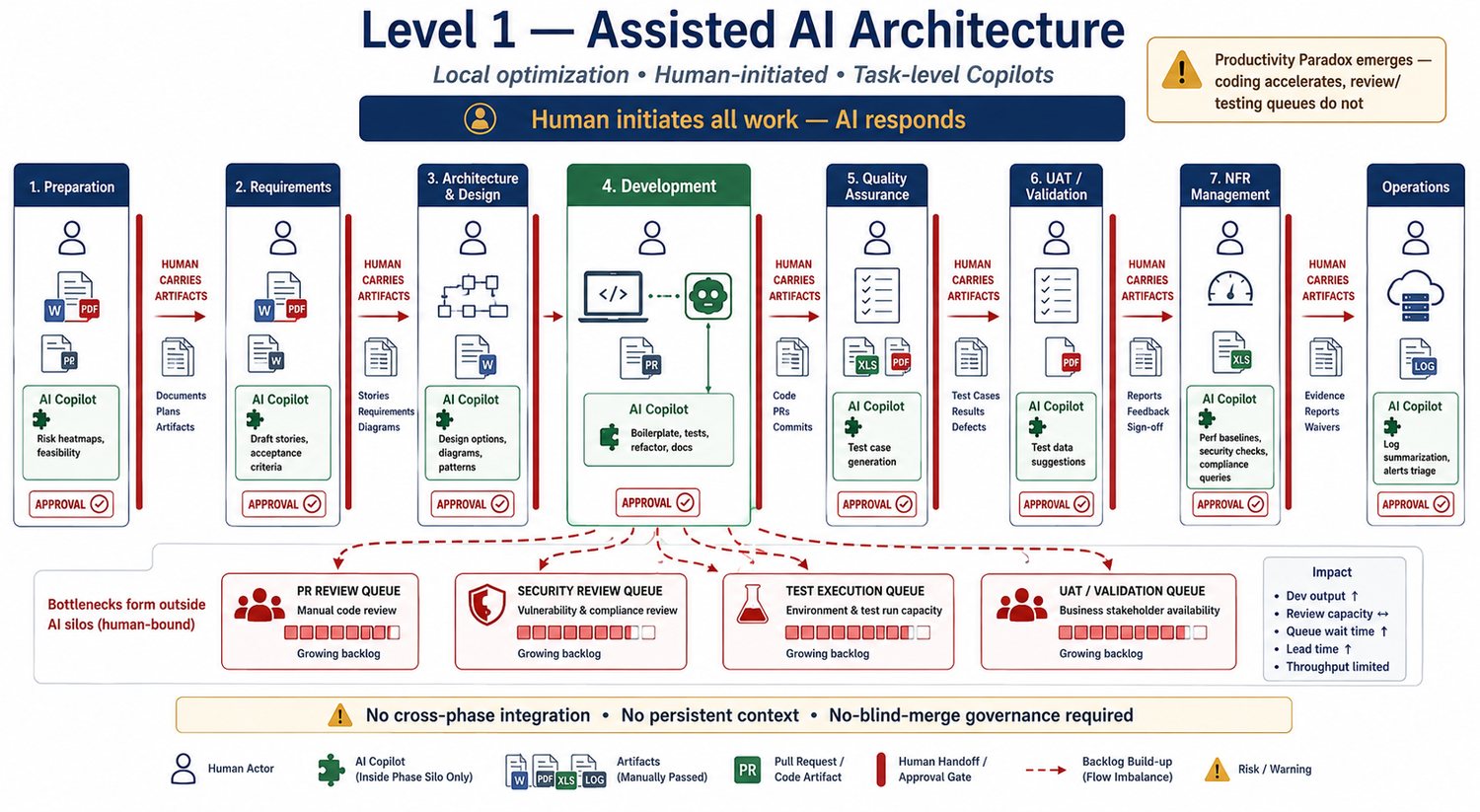
Level 1 is the first significant bridge on the Ag‑DLC journey. It introduces AI to help individuals perform specific tasks more efficiently within isolated silos of the SDLC. AI serves as a Copilot for specific tasks — most commonly coding and documentation — but lacks integration across the end-to-end lifecycle.
This is the Incremental Adoption phase — perfect for team-level wins and proving AI value without overhauling the entire operating model. At this stage, AI is still purely reactive: a human asks, AI responds, and the human decides what happens next.
The shift from Level 0 to Level 1
Level 1 does not change the overall workflow — humans still lead every decision — but it changes what happens inside individual tasks:
| Dimension | Level 0 (Traditional) | Level 1 (Assisted AI) |
|---|---|---|
| Primary role of AI | None | Assistant / Copilot |
| Workflow execution | Human-led; document-heavy | Human-led; AI-assisted |
| Context | Scattered in silos | Limited to current specific task |
| Initiative | Human initiates all work | Human initiates; AI responds |
Pillars of assistance
The shift is narrow but important: AI gains a seat at the task level, but not yet at the workflow level. Here is where assistance lands across the SDLC — and which pillars see the most immediate return:
| SDLC pillar | AI application | Impact |
|---|---|---|
| Preparation & Scoping | Risk heatmaps, feasibility reports, conflicting-objective identification | Medium |
| Requirements Detailing | Drafting user stories, acceptance criteria, "Ambiguous Words Reports," transcript-to-PRD | Medium |
| Application Development | Boilerplate generation, unit-test creation, code explanation, refactoring, ADR generation | High |
| Quality Planning & Testing | Test-case generation, synthetic and edge-case data generation | Medium |
| Operations | Log summarization, incident triage | Low |
Development is the power center at Level 1 — with the highest-impact Copilot applications concentrated in the IDE.
Projected benefits
Gains concentrate in individual task speed — directional ~26% more tasks completed, ~13.5% more commits, ~38.4% more frequent builds, and an estimated ~50% reduction in scoping and requirements first-draft time. Quality and traceability gains are limited; test coverage typically remains in the 60–70% range, and enterprise end-to-end delivery may lag these individual wins until later levels connect the chain.
Enforcing no-blind-merge
At Level 1, the human is the Doer and the Decision-Maker. Every line of AI-generated code must be vetted, edited, and approved. Human accountability is the only thing standing between a productivity boost and a technical-debt crisis.
It emerges here for the first time. Coding accelerates (~26% task throughput, ~13.5% more commits), but pull-request review, testing, and security queues do not keep pace — creating review fatigue and a growing backlog of unreviewed AI output. Teams that celebrate coding velocity in isolation are accumulating paradox debt: throughput rises while delivery speed stalls.
The structural response is deliberate governance — enforce no-blind-merge, and monitor PR review cycle time and defect-reopen rate alongside throughput, so the bottleneck is visible early, not discovered after leadership has committed to a false narrative of enterprise acceleration.
Exit criteria for Level 1
Level 1 is complete when the organization has maximized individual efficiency but hits a plateau where further gains are blocked by lack of cross-phase integration and persistent project context. The practical signal is the paradox inversion above: PR review cycle time rising even as coding throughput keeps climbing. Recognizing that pattern early means the organization is ready to invest in Level 2's toolchain integration.