What the paradox is
The Productivity Paradox describes a situation where individuals become significantly more productive using AI, but the organization as a whole does not see a proportional improvement in business outcomes such as delivery speed, quality, or cost.
This is a modern echo of the classic IT Productivity Paradox from the 1980s, and recent research shows the same pattern recurring with generative AI. The core insight:
Local optimization is not the same as system optimization.
Enterprise value depends on an entire chain — idea → requirements → design → development → testing → security → deployment → operations → customer value. If AI accelerates only one link in that chain while the rest remain manual, the overall chain barely moves.
Why it happens
The paradox is not mysterious once you look at where the friction actually moves. Coding gets faster, but the rest of the delivery chain does not automatically speed up with it — and in several cases, AI makes downstream work heavier, not lighter. Five recurring causes explain most of what organizations observe:
| Cause | Description |
|---|---|
| Bottleneck Shift | Coding accelerates, but review, testing, security, and governance become the new constraints. |
| More Code ≠ Better Software | AI generates more code, more pull requests, and more tests — increasing review and maintenance burden. |
| Quality Work Moves Downstream | AI creates drafts quickly, but humans still validate, decide architecture, review security, and integrate. |
| Coordination Overhead ("Botsitting") | Time spent writing prompts, correcting hallucinations, verifying outputs, and switching tools. |
| No Process Redesign | Organizations add AI Copilots without redesigning the underlying SDLC. |
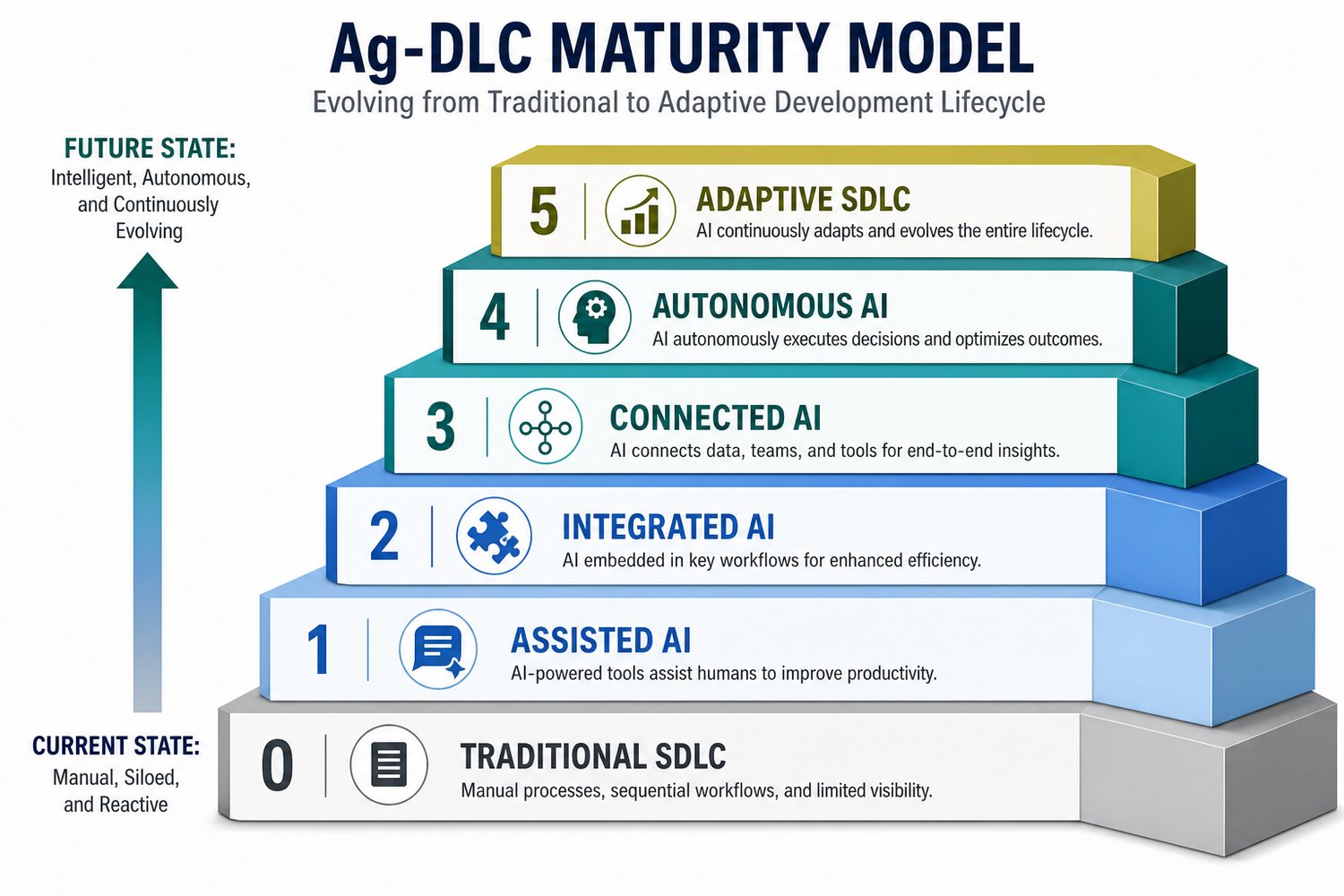
Together, these causes share one theme: AI accelerates production inside a system that was never designed for machine-speed output. The maturity levels that follow are, in part, answers to each — integration across phases, end-to-end connectivity, agentic orchestration, and closed-loop learning each remove a different bottleneck the paradox exposes.
The mathematics of the paradox
The following is a simplified, illustrative example — not empirical data — used purely to demonstrate the mechanism:
Requirements(5) + Design(4) + Coding(10) + Testing(8) + Review(5) + Deploy(3) = 35 days
Requirements(5) + Design(4) + Coding(5) + Testing(8) + Review(5) + Deploy(3) = 30 days
Result: Coding is 2× faster, but total delivery time improves by only ~14%. The bottleneck simply relocates.
The foundational research
- Brynjolfsson, Rock & Syverson (2019) argue AI is a General Purpose Technology whose benefits appear slowly, and only after complementary investments in process redesign, organizational change, skills, and governance.
- A 2025 survey of 415 software practitioners found GenAI can accelerate tasks while redistributing effort to review and verification — surfacing a developer-level productivity paradox.
- Recent theoretical work models why excessive AI assistance can, under certain conditions, reduce productivity through overreliance and skill degradation.
- Research focused on software engineering finds the real constraint is specification and governance quality, not raw model capability.
- Industry reporting (GitLab AI Accountability Report; Glean Work AI Index) corroborates that developers report faster coding while review, validation, and governance become the dominant constraints — an average of ~6.4 hours/week spent "botsitting."
Escaping this paradox requires more than faster typing — it requires progressively re-architecting how the entire delivery system works, level by level. The level sections that follow trace this paradox at each stage: when it appears, how it manifests, and what structural response that level provides.